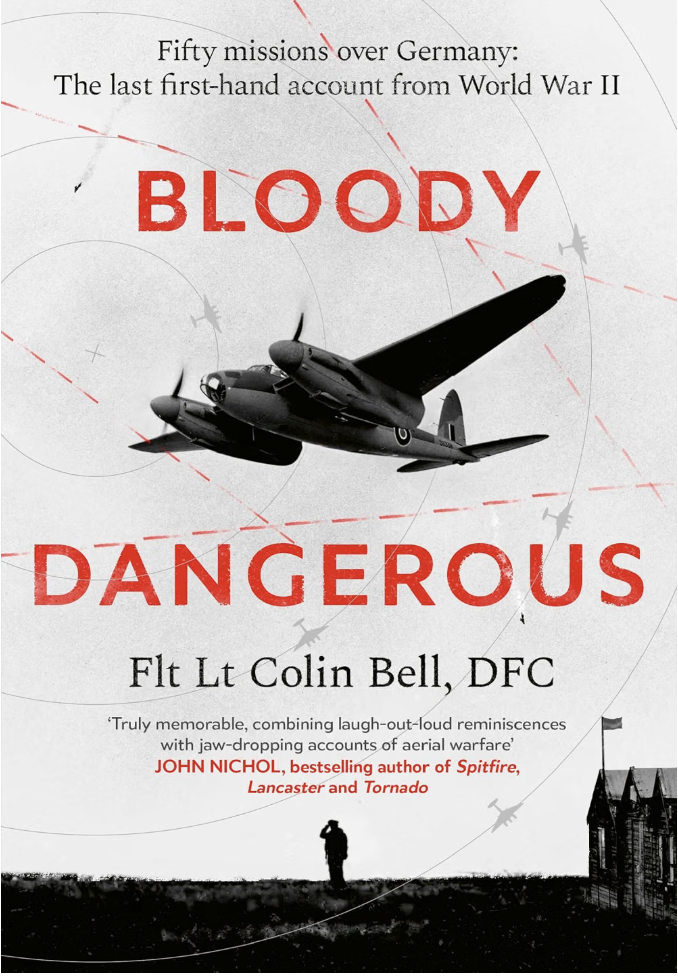
As I write this, it has been 99 years since Charles Lindbergh's crossing of the Atlantic, 86 years since the bombs dropped on London during the Battle of Britain, and 82 years since D-Day and the amphibious landings on Normandy. Colin Bell was there when Lindbergh flew through London days after his crossing, there to witness the bombs dropping on London, and there providing air supoort during the days before and after D-Day. But that isn't even the remarkable part of his story, which involve 50 missions over Germany in the airplane known as the "Wooden Wonder." After 70 years, Colin has written, "Bloody Dangerous," a marvelous tale of his life as a De Havilland Mosquito pilot. (And much more.)
— James Albright
Updated:
2026-10-01
Colin Bell: A Dream of Wings
After Charles Lindbergh crossed the Atlantic in the Spirit of St. Louis in May 1927, the first person to do so solo from New York to Paris, he visited Britain’s Croyden Aerodrome. In attendance was 6-year-old Colin Bell. His father got Colin and his brother Kenneth spots atop the airfield hotel. Colin asks today, “Could I be the last person alive to have been there on that day?” We don’t know the answer to that question, but we do know that “from those days on, it was my dream to learn to fly.”
He knew, however, that his prospects were low. In those days, pilots were picked from public schoolboys who had been captain of cricket or some other sport. “I barely went to school at all.” His schooling ended at age 16, but he was fortunate to get hired as a pupil in a firm of chartered surveyors. And so the die was cast: Colin Bell’s future career was as a chartered surveyor. But then Adolf Hitler intervened one evening during the late summer:
“I noticed a solitary Heinkel bomber low in the sky. Turning towards him, I could see that he was at around 800 feet, no more. Quite likely, he saw me too, though I would not have been his target. It just happened that I was at that moment approaching Hampton Court Bridge, which in retrospect, was obviously what he was aiming for. Anyway, he casually, or it seemed to me, lobbed out a solitary bomb as he swung round overhead. I clearly heard the thing come whistling down before exploding in a flash of violet light and found myself being thrown to the ground as an almighty crash erupted and everything and everyone nearby was blotted out in a cloud of smoke and dust. It turned out that the bomb had missed the bridge and instead hit the house on the other side of the road to where I had been looking up at him. It was just as well that it was only a small bomb, otherwise I would not have survived. Rising unsteadily to my feet, I brushed myself off, thinking that the sooner I joined the Air Force the better. It might give me the opportunity to catch up with the bastard.”
Bell got his chance, but first he needed to become a pilot. Not long after joining the Royal Air Force he was sent to the United States where he entered what was known as the “Arnold Scheme,” a plan by General Hap Arnold that trained nearly 8,000 cadets. The primary American trainer at the time was the Boeing P17 Stearman. Bell noted the American practice of covering up the airspeed indicator forced the student “to fly literally by feel, or as they say, by the seat of your pants.” He adds, “I suppose this feature of the American flight training system resulted in a somewhat higher attrition rate early on the budding pilots’ careers. But I suspect that, over the long term, it saved rather more lives than were lost as a result. I, for one, can think of several occasions when it saved mine, and that of my crew.”
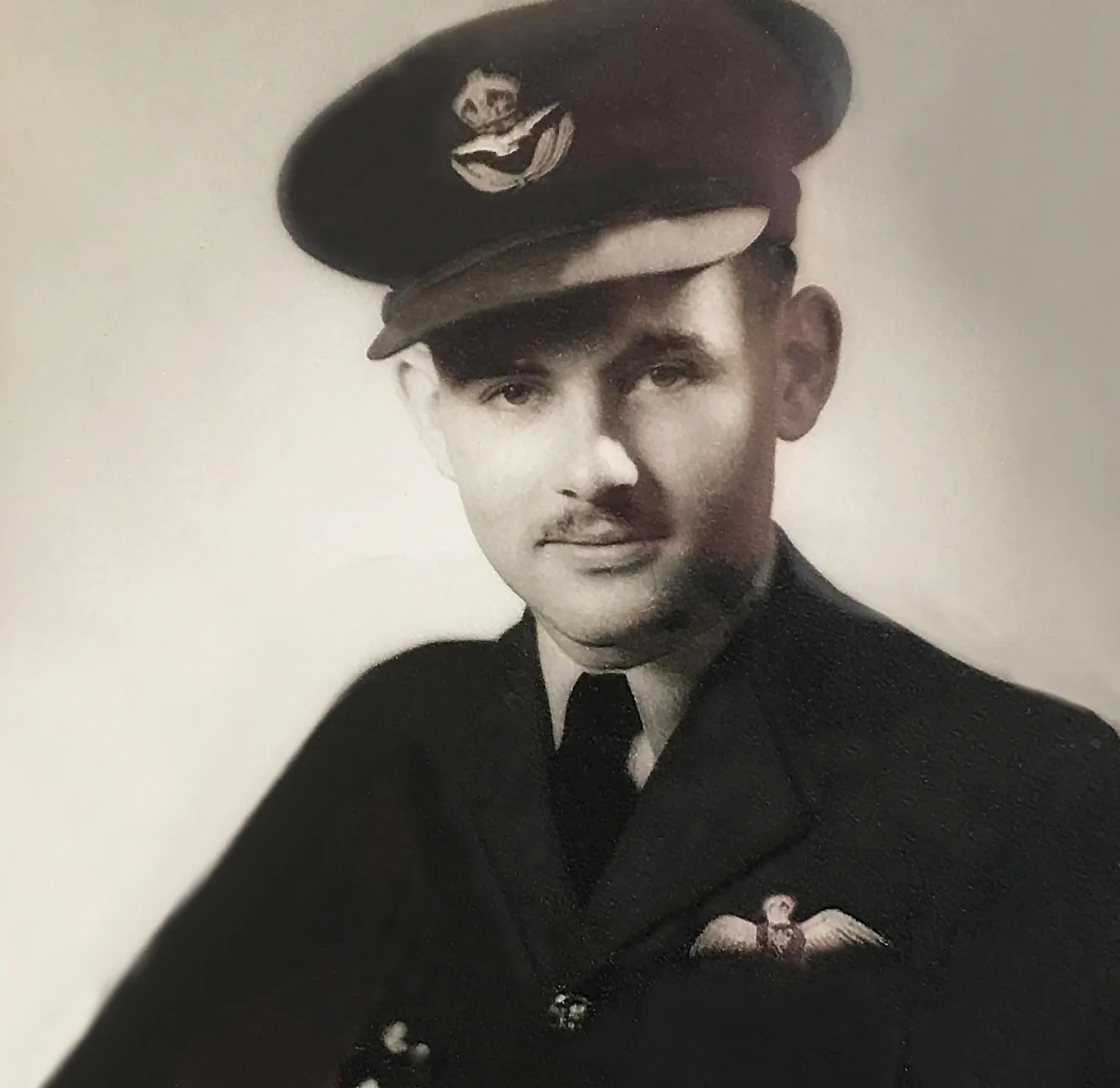
When he got his wings he also got two surprises: a commission as an officer and an assignment to stay in the U.S. as an instructor. He left Britain for the U.S. in late 1940, returned to Britain in 1943, and wasn’t assigned to Mosquito conversion until 1944. But once that happened, it happened quickly. He and his navigator Doug Redmond flew 11 training flights in six days and were sent off to combat a week later.
The Wooden Wonder
When it entered service in 1941, the de Havilland DH.98 Mosquito was the fastest operational aircraft in the world, able to exceed 400 mph. The fuselage was a molded plywood-balsa-plywood sandwich, and the wing was largely wooden, hence the aircraft’s nickname, “The Wooden Wonder.” Its combination of highspeed and ability to reach high altitudes made it difficult for most German fighters to intercept. The Mosquito’s relative immunity from interception lasted until the introduction of the Me 262, Germany’s first jet fighter. One of that fighter’s weaknesses was a huge turn radius. Bell writes about being intercepted by the jet fighter on one of his last missions, but being able to outmaneuver it and escape.
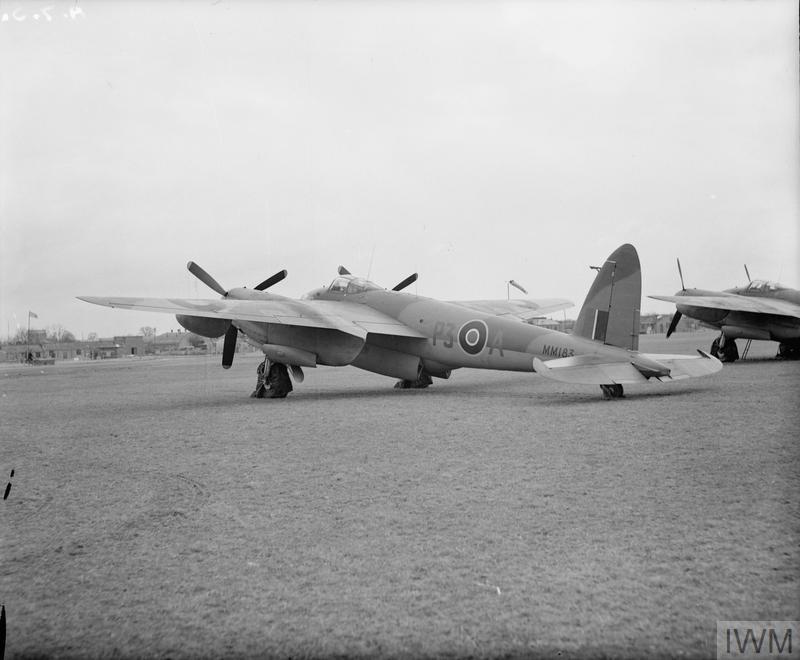
De Havilland DH 98 (Imperial War Museum photo)
Bloody Dangerous
The usual combat tour in the Mosquito was 50 operations, higher than those of main force bombers such as the Lancaster or Halifax. Bell flew exactly 50 combat missions over Germany and goes into each in his book, “Bloody Dangerous,” written over seventy years later. He takes us from pre-war London and his time with the Pathfinder 608 squadron. The title was inspired from a mission over the Kriegsmarine base at Emden, where spotlights locked onto his aircraft and exploding shells caused the aircraft to shudder. Bell put the airplane into a nosedive and said, “this was an error.” It took all his might and quick work with the trim wheel to pull out of the dive. “This is why the first four or five raids are so dangerous, you make stupid mistakes.” His navigator goes on with providing heading corrections. “His voice is icily calm.” After some silence, Bell says, “You know what? I’m beginning to think this business might be a bit bloody dangerous after all.”
Coned!
The Germans used Würzburg fire-control radar to home in on the aircraft’s electromagnetic reflection. The Wooden Wonder contained a lot of metal, not the least of which were its two Rolls-Royce Merlin 72/73 or 76/77 Engines. The radar then directed a master searchlight and once illuminated, other lights would follow, giving anti-aircraft gunners something to aim at. Crews were encouraged to maneuver out of the cone, but minutes before bomb release there was only so much you could do. Bell describes being quite literally blinded by the light.
Mosquito Pathfinders would use the AMES Type 9000, cover name Boomerang, but more often called Oboe. Navigators would keep the aircraft on a precise track by listening to the Morse-like tones heard from two ground stations. Once on course, the sound became a continuous tone, which is why some navigators said they “played by ear.” At a predetermined release point, they dropped purpose-built pyrotechnic weapons called Target Indicators which following Lancasters and Halifaxes would use as aiming points.
Mission Over Safety
We in modern Air Forces often talk about the priority of mission over safety, but safety usually wins out over many (if not all) peacetime missions. In wartime? All bets are off. Bell writes about when his squadron commander learned their Merlin engines were fitted with “weak conrods” (the rod that connected each piston to the crankshaft) and the manufacturer proposed to ground the fleet for six weeks for retrofit. If a conrod were to fail during takeoff, even on just one of the two engines, the result was unsurvivable. The squadron commander refused, “not for six days, let alone six weeks!” When asked what they were supposed to do if they had an engine failure during takeoff, his answer was unequivocal. “You die like an officer and a gentleman.”
The Difference Between a Court Martial and a Commendation
Many of Bell’s combat stories offer flying lessons to us in the military and as civilians. One of my favorites took place after the war ended, with Bell flying mail runs in his beloved Mosquito. He was flying from Istres, France back to his base in England. A warrant officer asked for a ride home and Bell agreed, telling the man he would have to fly in the bomb-aiming compartment, which was not rated for takeoffs or landings. The warrant officer agreed. During takeoff, the port tire burst. Procedure was to retract the other gear and land on its belly, which was sure to crush the nose section. This left Bell in a bit of a conundrum. “I would be left to explain why there was a corpse in the front of my aeroplane.” He decided to land the airplane on its only main wheel. “I found myself at the controls of a wild animal.” But he managed to stop the airplane, and everyone survived. He got called in to see the wing commander.
“I had orders from Group that if there was any damage to the aircraft, you were to be court-martialed.”
“Well, sir,” I replied, “if I hadn’t got away with it, I rather think there wouldn’t have been anyone left to court martial.”
At this, he laughed. And, as well all know, when the wing commander laughs, everyone laughs.
“So as it is,” he went on, “I am instead going to enter a commendatory endorsement in your logbook. Congratulations!”
We often joked in my part of the Air Force, “Sometimes, the only difference between a court martial and a commendation is the title on the top of the certificate.”
The Book
As you should be able to tell, I very much liked “Bloody Dangerous,” Colin Bell’s memoir of his path from an ordinary young Englishman with an ambition to fly to becoming a wartime Mosquito pilot. His route to combat was remarkably circuitous: rejected initially by the RAF, he eventually trained as a pilot, spent about a year in the United States as an instructor, endured further delays and conversions after returning to Britain, and finally joined No. 608 Squadron RAF. Flying the de Havilland Mosquito with his navigator, Bell became part of the Pathfinder Force. His accounts of operations over occupied Europe and Germany—including being “coned” by radar-directed searchlights, intense antiaircraft fire, engine problems, and encounters with German fighters—convey how extraordinarily dangerous these missions were despite the Mosquito’s speed and performance.
The book is also very much the story of the man outside the cockpit. Bell writes about his courtship and wartime marriage to Kathlyn (“Kath”), friendships and the sometimes frustrating machinery of RAF training and postings, and the transition back to an entirely ordinary civilian life after experiencing extraordinary things. He returned to being a chartered surveyor and rarely spoke publicly about his wartime experiences for decades. That long perspective is part of what makes the memoir distinctive: rather than presenting himself as a heroic figure, Bell recounts the war with humor, understatement, and a striking memory for incidents and personalities. The title Bloody Dangerous captures that tone particularly well—the retrospective realization that what these very young men regarded at the time as simply their job was, in fact, bloody dangerous.
The book is available at Amazon.