Most of what you read about the crash of Korean Air 2033 on August 10, 1994 is based on early news reports that were little more than speculation: the first officer called for a go around but the captain refused. The story was too good to pass up, so more and more news was based on these faulty reports. And here we are, thirty-two years later, and we have new stories based on the old speculation. I believe most of these stories are just wrong. There are lessons to be learned here, but not the lessons you get from most of these sources.
— James Albright
Updated:
2026-08-05
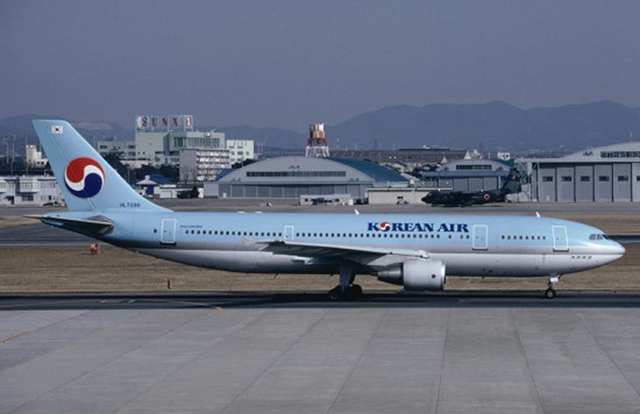
HL 7296, from Aviation Safety Network
There are several sources on the Internet that claim the Korean first officer called for a go around prior to the landing and the Canadian captain refused. The normally reliable www.tailstrike.com has a "transcript of the Cockpit Voice Recorder" that includes the following line: "At this moment, the Co-pilot decides that there is insufficient distance for the Airbus to land safely without crossing the end of the runway. The Co-pilot, when the aircraft is only 30 feet off the ground, decides to "go around" and pulls back on the yoke." Wikipedia shows a "Cockpit voice recorder transcript" that says the copilot said "Go around" at 100 feet. I cannot find any primary source that backs any of this up.
When I first read these reports I was suspicious because the scenario goes against previous Korean Air crashes and the culture at the airline. At the time, the authority gradient between captains and first officers was quite steep. First officers in many cases sat humbly, knowing they were about to die. The reported CVR transcripts ran contrary to the airline's history. Parts of the report are available but they are written in Korean. I've had the report translated and it includes only CVR excerpts. What is printed doesn't show that the first officer called for a go around against the captain's wishes, only that he started to pull against the yoke while the captain was executing the flare, the captain said "get off" and the copilot then said "go around.""
- Date: 10 AUG 1994
- Time: 11:22 LT
- Type: Airbus A300B4-622R
- Operator: Korean Air
- Registration: HL7296
- Crew: Fatalities: 0 / Occupants: 8
- Passengers: Fatalities: 0 / Occupants: 152
- Total: Fatalities: 0 / Occupants: 160
- Airplane fate: Written off (damaged beyond repair)
- Location: Cheju Airport (CJU) (South Korea)
- Phase: Landing (LDG)
- Nature: Domestic Scheduled Passenger
- Departure airport: Seoul-Gimpo (Kimpo) International Airport (SEL/RKSS), South Korea
- Destination airport: Jeju (Cheju) International Airport (CJU/RKPC), South Korea
1
The crew
Korean Air has through the years employed foreign nationals as captains, at first just because they needed the expertise and later because other nations threatened to refuse their airspace until the airlines of Korea improved their safety record. The U.S., for example, did just that in 2001. More about that: The Airlines of Korea.
The captain of Flight 2033 was a 53 year-old Canadian national who didn't speak Korean. It appears he had 13,207 total flight hours, of which 2,758 were in type. The first officer was a 36 year-old Korean who was said to have poor English skills. It appears he had 3,195 total flight hours, of which 316 were in type.
2
What we know happened
Piecing together what happened from the Accident Report, requires "reading between the lines," which I suppose is where much of the speculation comes from. What follows is what is in the translated report and where I need to speculate, I'll do so explicitly.
The flight was a scheduled domestic trip from Seoul (Gimpo International Airport) to Jeju Airport on an Airbus A300. On board were the 2 pilots, 7 cabin crewmembers, and 152 passengers.
The weather included heavy rain and reports of windshear. The winds were 140° / 18 to 25 knots. Runway 06 was in use and was wet.
The crew opted for a lesser flap setting (15 versus 20), because of the possibility of windshear.
The CVR indicates that the first officer made a comment about the excessive speed before touchdown and the captain replied "Okay, I know."
The FDR shows that the aircraft crossed the runway threshold high and fast. They crossed at 185 kts, their planned approach speed was 160 knots, VREF was 147 kts.
At 11:21:02, the captain said, "Get off."
At 11:21:32, the First Officer misunderstood the Captain’s statement “Get off” and confirmed it as “Go Around?” The Captain responded “Yes.”
Why did the captain say "get off" at that moment, just prior to or during the flare? The captain was an English-speaking Canadian and I believe what might have been happening was the captain had his hands full with the gusty winds and believed the first officer's hands were on the yoke and directed him to "get off" the controls.
The aircraft floated during the flare and touched down 1,773 meters (5,816 ft.) from the threshold. The runway was 3,000 meters (9,843 ft.) long.
Thrust reversers were deployed 1.2 seconds after touchdown and manual braking was applied.
The aircraft was unable to stop within the remaining runway distance, departed the runway end, and collided with an airport perimeter embankment. A post-impact fire occurred.
3
My analysis
My first thought when reading reports of Korean Air 2033 was that it didn't make sense. In the eighteen years prior to this accident, there were 9 crashes of airlines of Korea: Korean Air Lines 642, Korean Air Lines 902, Korean Air Lines 015, Korean Air Lines 007, Korean Air Lines 084, Korean Air 803, Korean Air 221, Korean Air 852, and Asiana Airlines 733. Of the crashes directly attributable to the pilots, one crew failed to turn after takeoff and flew into a mountain, another crew ducked under the ILS glide slope, another captain taxied to the wrong runway and attempt to takeoff, another crew attempted to land using an ILS they knew was out of service, another crew failed to deice before takeoff, and another crew failed to use their before landing checklist and landed with the gear retracted.
In the six years that followed Korean Air 2033 there were three more crashes, each directly attributable to the Korean national captain's incompetence: Korean Air 801, Korean Air 6316, and Korean Air 8509. Two common themes emerge from many of these accidents: pilot incompetence and what looks like a squashing of evidence to suppress what really happened.
Korean Air 2033 follows these themes, at least in part. There is very little information publicly available about the accident other than an untranslated and incomplete accident report and news reports that appear to have little actual evidence behind them. I do have a few other sources but many of these appear to have their own agenda because of subsequent efforts in Korea to send both pilots to prison. (Korea has done this before, sending the pilots of Korean Air 8052, for example, to between 8 and 10 months in prison.) In the case of Korean Air 2033, both pilots were arrested but prosecutors ultimately declined to pursue convictions.
As for the pilots, that is a bit of an exception from all the rest. Of each of the accidents I've cited here, Korean Air 2033 was the only one that involved an expatriate pilot, that is, a pilot working in a country that he or she is not a citizen. Both Asiana and Korean Air were downgraded internationally in 2001 for their abysmal safety records, and hired many expats to help "right the ship." But that was long after Korean Air 2033.
If you watch some of the videos and read some of the translated transcripts, you will be told the first officer said "go around" and then the captain said "get off," leading you to believe the first officer commanded a go around which the captain ignored. But if you examine the untranslated Korean accident report, you see that the captain said "windshield wiper," which the first officer replied with, "windshear?" Then, the captain said "get off," to which the first officer said "go around?" We don't know the inflection of the voices to know if that last bit, "go around," was a question or a command. The English translation I have says that the first officer interpreted "get off" as "go around."
I was sent a copy of a Technical Report by J.M. Bélanger, a Canadian Safety Investigator who attended the reading of the Flight Data Recorder (FDR) and Cockpit Voice Recorder (CVR), with the authorization of the Republic of Korea Civil Aviation Bureau.
During the landing flare, it is evident from the CVR that the First Officer interfered with the Captain's control inputs. The CVR and FDR show that when the aircraft is at an altitude of 25 feet over the runway on the centerline and approximately 1,500 feet downfield from the threshold, the Captain is clearly heard as saying, "Get your ha.. get off. Get off, Tell me what it is." The FDR shows a nose up elevator input, a pitch up of the aircraft and a sudden and significant power increase (1.10 EPR to 1.20 EPR). The FDR data shows that the touchdown speed was 104 knots.
Source: Technical Report, Bélenager, p. 4
I cite only this passage as it clearly shows there was interference with the captain's control inputs during the flare. While Bélanger's qualifications as a professional engineer, air safety investigator, and pilot for Air Canada are not in dispute, the writing of his report shows a clear bias in favor of the Canadian Captain. He ignores or excuses the following:
- The captain flew an unstable approach.
- The captain's phraseology throughout the landing was nonstandard, making the first officer's poor English understanding even worse.
- When it became obvious they would not have touched down in the first half of the runway, the captain should have aborted the landing and gone around.
It is important to examine the captain's actions with the lens of what we knew and how we flew airplanes back in 1994. The idea of a stable approach gate at 500 feet was in its infancy and I doubt many professional airline pilots back then would have thought twice about stable approach parameters in this situation. Korean Air as an airline had poorly written and enforced Standard Operating Procedures leading to the nonstandard callouts by both pilots. The idea of "continuation bias" may have been known by many in aviation at the time, but it wasn't an emphasis item in most aircrew training.
We pilots are result driven; we are there to get the job done. The captain's role is to safely fly the airplane from Point A to Point B and once in that mode, it is easy to ignore warning signs that get in the way. Windshear warnings? Heard them before, we can fly through most windshear alerts. A little high and fast on final? Easily dealt with. Landing going to be a bit long? The brakes can handle it. When you are in the heat of battle, it is easy to have a bias toward continuing the job at hand. This is why we need strict stable approach rules and very strong SOPs. They did not have either at Korean Air in 1994 and for many years to follow.
4
The lessons
The probable cause section of the report:
The accident was caused by the captain's excessive approach speed and improper landing technique in deteriorating weather conditions, combined with inadequate crew coordination and failure to adhere to stabilized approach criteria, resulting in a runway overrun. Contributing factors were windshear and heavy rain, improper flap configuration, failure to execute a timely go around, inadequate callout procedures, and CRM deficiencies.
Recommendations included: Strengthening CRM training, Reinforcement of stabilized approach criteria, Standardization of callout procedures, Improved English proficiency training, Enhanced simulator training, Installation of wind shear detection equipment, and Revisions to operational manuals.
In my view, mixing a highly experienced captain with a first officer with very little experience can only work if the captain is a patient instructor and the first officer is confident and willing to speak up. But a prerequisite to success is that both pilots are proficient in the same language. The report's recommendations provide a good list of lessons, but could go further:
Standard Operating Procedures in the form of proper checklist usage, call outs, and stable approach criteria empower the pilot monitoring to speak up and depersonalize corrections so that captains can realize they aren't being personally challenged by the younger pilot, only called on to adhere to a higher standard.
Landing performance needs to be considered prior to every landing, to include the impact of landing flap selection in view of the winds and runway contamination. Knowing you will need three-quarters of the runway should be adequate motivation to not salvage a landing halfway down the runway.
Rejecting a landing after touchdown and thrust reverser deployment is rarely a good idea.
Pilots must have a common language. A successful strategy employed by some airlines flying culturally mixed crews is to have a definite list of vocabulary and phrases that covers all normal and anticipated non-normal situations.
References
(Source material)
항공기 사고조사보고, 대한항공 A300-600, HL7296, November 1994, Ministry of Transportation (Republic of Korea)
Technical Report, Korean Air 2033, August 10, 1994, Accident Investigation in Cooperation with Bureau of Enquites Et Accidents Paris, August 24, 1994 by J.M. Bélanger, P.Eng.